EPIRB Checks: Self-Test and Supporting Document
RS and RKO rules: practical application
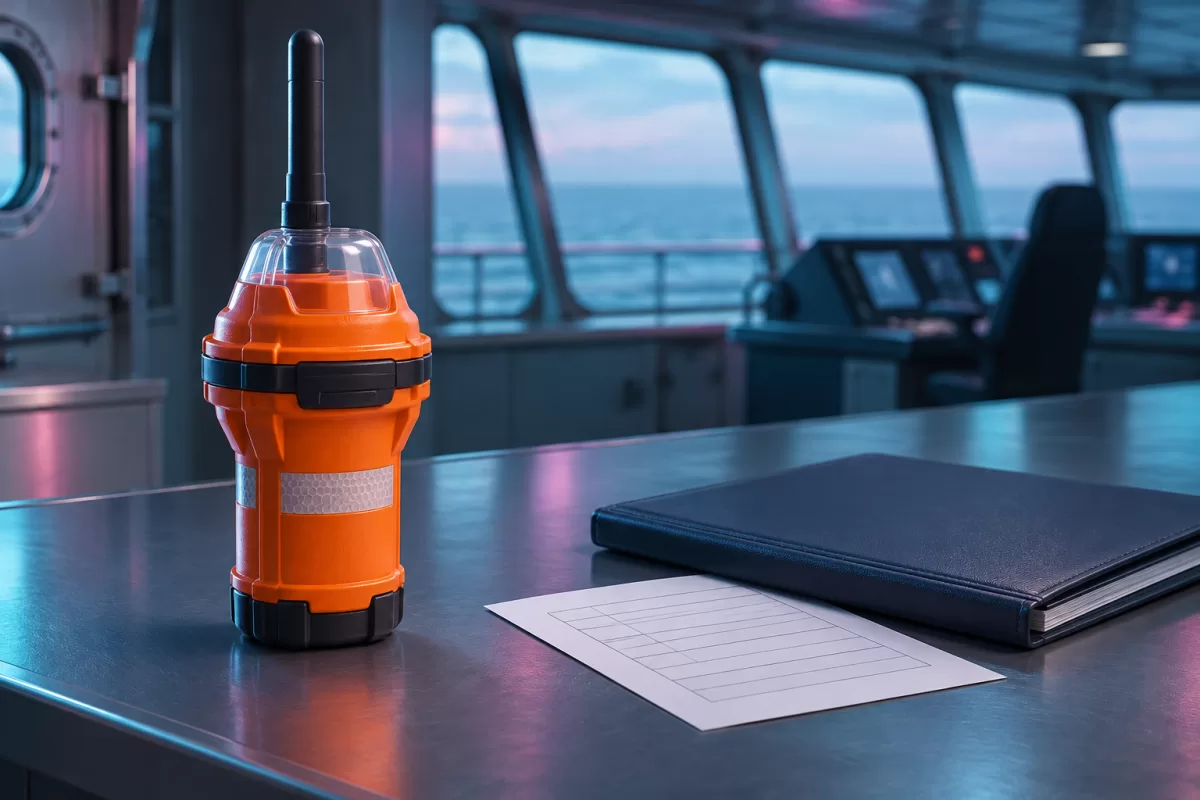
A successful EPIRB self-test answers a specific technical question. When accepting equipment on board, also establish which document confirms the required check of that particular unit. In an enquiry for the NSR NEB-2000 , keep these details separate: the built-in test result, the inspection document and the service dates are different records.
Two requirements in the same section
Clause 2.6.8.22 of Part VII, Radio Communication Equipment, of the RKO classification and construction rules (PKPS) requires an EPIRB to be testable without using the satellite system. Clause 2.6.8.13 in the same section calls for checks and a document confirming operability based on their results, under the procedure established by the authorised Russian state body.
The built-in test indication and the supporting document serve different purposes. A test-passed indication alone does not establish whether the required documented check has been carried out. The document should identify the unit and the basis for its issue.
This article uses the edition of Part VII introduced by RKO Order No. 29-p of 31 March 2026, with subsequent published amendments. Part VII covers inland and inland-seagoing vessels. Section 2.6 covers GMDSS equipment for classes M-SP, M-PR and O-PR. Under clause 1.1.2, unless otherwise specified, vessels and equipment in service remain subject to the requirements under which they were built or manufactured. Under clause 1.1.5, additional flag Administration instructions take precedence where they differ. Determine the applicable edition and acceptance procedure for the particular vessel.
Coding, registration and identity checks are covered in the article on preparing an EPIRB for a specific vessel. This article addresses a narrower question: what a self-test record can establish.
What is documented for the NEB-2000
NSR describes the NEB-2000 as a marine COSPAS-SARSAT EPIRB with a built-in GNSS receiver and AIS transmitter. Brochure V16 lists a self-test function, and the model page notes automatic power-off after the test. These sources establish that the manufacturer provides the mode. They do not establish the results of a specific completed test.
To assess a particular record, use the manual for the exact version and the device's actual indication. A statement such as serviceable is difficult to compare with a service report unless the test mode is known. A photograph of the indicator can record the observation. Check its meaning against the manual and the scope of the required check against the applicable procedure.
What to request for supply or service
| Information | Why it is needed |
|---|---|
| EPIRB model and serial number | Link the result and document to the unit being supplied to the vessel. |
| Date, mode and result of the completed check | Identify what was done and what was recorded. |
| Inspection document, date and issuing organisation | Confirm documented operability under the applicable procedure. |
| Next shore-service date and power-source markings | Assess the dates separately. A successful test does not change the dates marked on the equipment. |
| Manual for the offered version | Compare the mode designations and indications with the unit documentation. |
Clause 2.6.8.6 lists the next shore-based service date and the battery storage expiry date as separate items to show on the outside of the EPIRB. A single date in a quotation leaves it unclear which one it refers to. Ask which activity or component the date concerns. These clauses do not establish a universal service interval based on the model name.
How to write the service enquiry
Provide the vessel type, applicable requirements, model and serial number, observed result of the standard test and available documents. If the result is unsatisfactory or unclear, give the service organisation the exact indication. Use the manual and the vessel's procedure to determine the next action.
When buying an NEB-2000, ask for confirmation of the actual version, documentation and preparation required before delivery to your vessel. Follow the manual for the specific unit when starting a test. This article does not prescribe a sequence of controls or suggest testing the beacon by transmitting a real distress alert.
Sources: official RKO listing for the classification and construction rules, Part VII, Order No. 29-p, clauses 1.1, 2.6.8.6, 2.6.8.13 and 2.6.8.22; NSR NEB-2000 product page and brochure V16.
More in this series
- Portable GMDSS: gloved operation and readiness for use
- New equipment near the magnetic compass: what to agree
- Echo-sounder trunk: access and water detection
- AIS: accounting for audible fault alarms
- NGR3000 antenna: information needed before choosing a location
- Echo-sounder cable: routing, shielding and deck connections
- EPIRB: float-free release and access to the container
- AIS-SART: the mounting arrangement is part of the package
- NTW-1000: checking the emergency-battery expiry date
- Echo-sounder transducer: conditions around the installation site
- Position source for GMDSS: include power supply in the brief
- AIS pilot plug: what to agree for the bridge
- DSC watchkeeping: the alarm must cover the whole bridge
- NAVTEX: bringing an SAR message to the watchkeeper's attention
- Speed log for a project: speed through the water or over the ground
- EPIRB for a particular vessel: data, markings and documents
- AIS class in the enquiry: start with the vessel's requirement
- Portable GMDSS: storage and transfer to survival craft
- Marine VHF antenna system: what to include in the work specification
- Charging the radio reserve battery: monitoring on the bridge
- Replacing an echo sounder: installation design and onboard documents
- Grounding a navigation instrument: what to include in the design
- Navigation switchboard: separate feeders and connected loads