AIS-SART: the mounting arrangement is part of the package
RS and RKO rules: practical application
For NSR NAS-1000 agreeing only on the transmitter housing is insufficient. If the equipment is intended for the specified search-and-rescue use, determine how it will be mounted in the survival craft: the accessory, compatible mounting socket and associated instructions. The pole length in a product list and the antenna's height above the water describe different quantities.
The manufacturer confirms the model's intended use
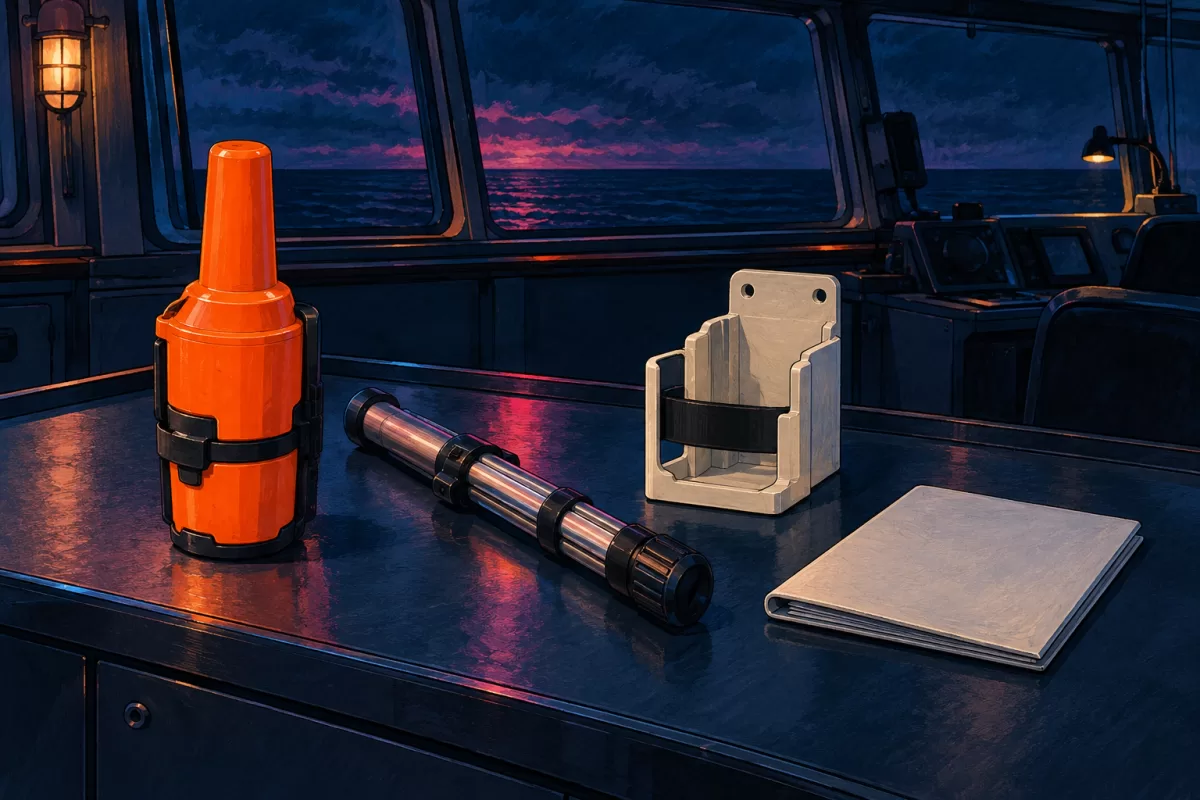
The NSR NAS-1000 AIS-SART rev15 brochure describes the product as intended for emergency use on a liferaft. Its equipment list names the transmitter, mounting bracket, 1.5 m telescopic pole and accessories. Compare this list with the actual contents of the particular quotation.
Neither the ship's AIS for routine data exchange nor a satellite EPIRB is presented as a substitute for NAS-1000 merely because it is described as emergency equipment. Their roles in the vessel's equipment are determined by the applicable documents. This article concerns the mounting package specifically for an AIS-SART.
Where the RKO clauses apply
This article uses Part VII, Radiocommunication Equipment, of the RKO Rules for the Classification and Construction of Ships, introduced on 3 April 2026 by Order No. 29-p, taking subsequent amendments into account. Clauses 1.1.1–1.1.3 define the Part's scope; for an existing vessel and product, applicability of the edition is established under clause 1.1.2. Additional Administration instructions are considered under clause 1.1.5.
Section 2.6 concerns GMDSS equipment on vessels of classes M-SP, M-PR and O-PR. Clause 2.6.10 specifies AIS-SART requirements. Section 4.10 separately addresses installation of search-and-rescue locating devices: radar SART or AIS-SART. This article does not prescribe the required number or select a device type for every vessel.
The pole and antenna position: two related questions
Subclause 2.6.10.3 provides for a device that raises the AIS-SART antenna at least 1 m above sea level, with illustrated installation instructions. Clause 4.10.3 relates the pole or other device to the antenna mounting socket in the survival craft and the same required height.
Consequently, a line reading '1.5 m pole' does not itself confirm the installed result. Assessment requires the accessory configuration, installation-site information and documentation. Not every long rod is a suitable component, and a photograph of an assembled set cannot establish the required height.
State the survival craft's type and model, the known socket configuration and accessories to be retained. Missing information remains a separate matter to clarify. A photograph of accessible markings is useful; independently deploying survival craft simply for an enquiry is unnecessary.
Storage aboard ship and deployment are distinct
Clause 4.10.1 provides for the devices to be placed in brackets on each side of the ship, in a visible position inside the navigation bridge near the entrance doors; an outside location in direct view from the bridge is also permitted. Equipment must remain readily transferable to the lifeboats or liferafts.
The section includes specific cases: clause 4.10.2 concerns ships with at least two such devices and free-fall lifeboats, while clause 4.10.5 concerns bracket mounting in each lifeboat where transfer without delay is possible. Describe the existing storage position and intended use separately, rather than treating one arrangement as universal for all vessels.
Instructions and markings must accompany the package
In addition to the illustrated instructions required by 2.6.10.3, clause 4.10.3 specifies waterproof markings with operating instructions, battery expiry date, vessel name and call sign. These are specific items to check against the package. A photograph of one transmitter does not demonstrate that all documentation and accessories are included.
| Information to provide | Items to specify in the quotation |
|---|---|
| AIS-SART purpose under the vessel's documents | Required configuration and package contents |
| Survival craft type and model | Proposed socket and mounting arrangement |
| Identification of accessories to retain | Their documented suitability for use |
| Storage position and transfer route | Bracket and items associated with the operating position |
| Available instructions and markings | Documents and accessories in the actual supply |
For NAS-1000 confirm the particular package and the condition of its components. Compatibility and mounting conditions are established from the documentation; the article illustration is not an installation drawing. Availability, documents, cost and delivery schedule are agreed separately. This guide does not specify activation or test-transmission procedures.
Sources
- RKO: Part VII of the Rules for the Classification and Construction of Ships under Order No. 29-p: clauses 1.1.1–1.1.5, section 2.6, subclause 2.6.10.3, clauses 4.10.1–4.10.3 and 4.10.5.
- RKO: amendments under Order No. 70-p.
- NSR NAS-1000 AIS-SART: rev15 brochure, both pages.
- NAS-1000: SpectraTech's own product page.
The table and enquiry questions are editorial explanations. Sources consulted: 25 October 2026, Astana.
More in this series
- Portable GMDSS: gloved operation and readiness for use
- New equipment near the magnetic compass: what to agree
- Echo-sounder trunk: access and water detection
- AIS: accounting for audible fault alarms
- NGR3000 antenna: information needed before choosing a location
- Echo-sounder cable: routing, shielding and deck connections
- EPIRB: float-free release and access to the container
- NTW-1000: checking the emergency-battery expiry date