NTW-1000: checking the emergency-battery expiry date
RS and RKO rules: practical application
When ordering NSR NTW-1000 , the description "radio with two batteries" does not tell you how much life remains in the emergency battery. Before requesting a quotation, establish its exact designation, the dates on its label and the condition of the specified packaging. This is especially important when replenishing existing kits, since identical-looking radios may have accessories with different dates.
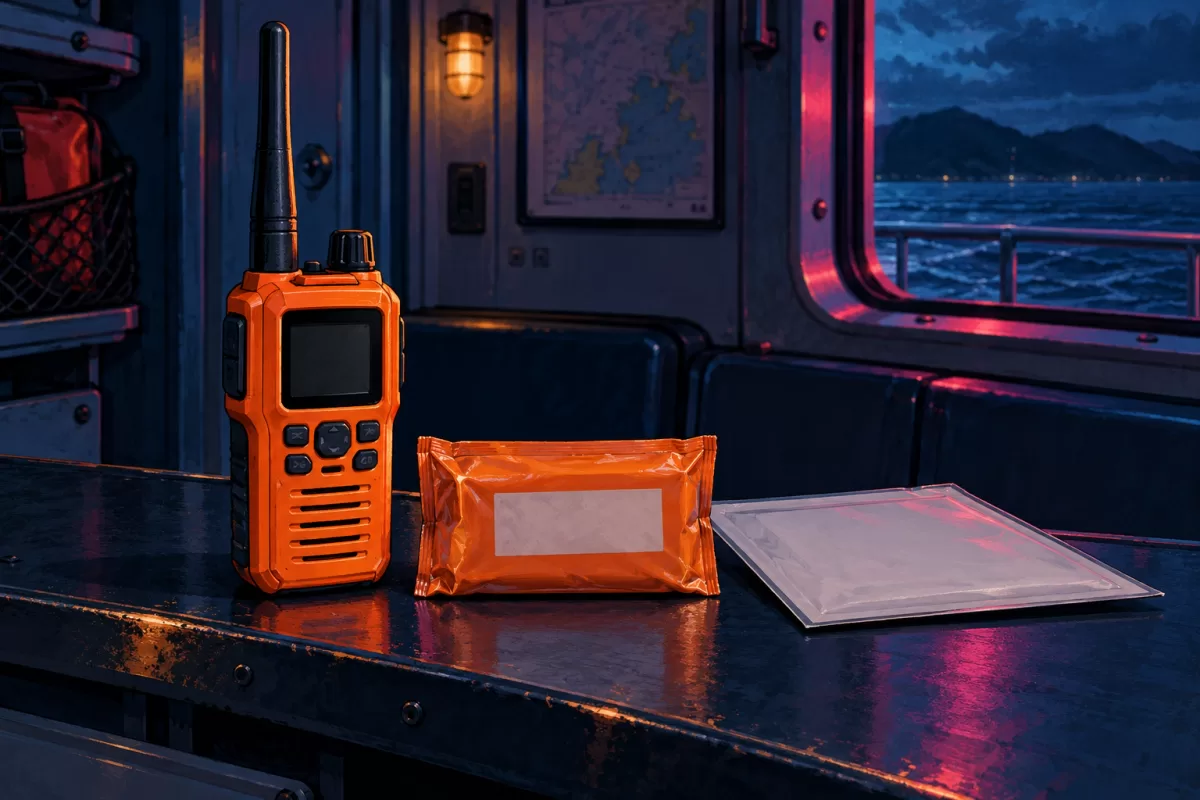
Why the emergency battery matters
NSR designed the NTW-1000 for two-way VHF radiotelephone communications for GMDSS survival craft. Brochure rev13 lists the NBT200 emergency battery and the rechargeable NBT200C separately. Record the exact battery version included in the proposed kit in the supply documents.
This article refers to Part VII, Radio Communication Equipment, of the Russian Classification Society (RKO) classification and construction rules (PKPS), introduced on 3 April 2026 by Order No. 29-p, with later amendments. Section 2.6 covers GMDSS equipment for vessels in classes M-SP, M-PR and O-PR. Clause 2.6.12 concerns portable two-way VHF radiotelephones. Clauses 1.1.1–1.1.3 define the scope of Part VII, and clause 1.1.5 covers additional Administration instructions. Use clause 1.1.2 to determine which edition applies to vessels and equipment in service.
The date the cells were manufactured matters
Subclause 2.6.12.29 bases the expiry date of the primary-cell battery on the date the cells were manufactured and their storage life. The purchase date of the radio is not the starting point.
Ask for information about the specific battery instead of counting an advertised period from the shipment date. A stated number of years without a date and conditions does not tell you the remaining life. A manufacturer’s stated life for a particular equipment revision also does not establish the date of a specific unit.
Subclause 2.6.12.26 specifies a service life of at least two years for primary-cell batteries. It does not promise a fresh two years from each sale. Determine expiry using the specified starting point and consider the actual markings alongside the applicable documents.
Where the dates should be visible
Subclause 2.6.12.28 includes the primary-cell battery expiry date among the information to show on the outside of the equipment. Subclause .30 separately calls for the date of manufacture and expiry to be clearly marked on the outside of the radio in indelible type and sets requirements for the durability of the label and its information.
When replenishing a kit, provide available photographs showing the markings and designations on the radio and battery. A handwritten date in an enquiry can start the discussion, but it does not replace the original marking and documents. Resolve any discrepancy before finalising the order.
Keep the packaging sealed when taking photographs
Subclause 2.6.12.23 covers radios with a user-replaceable power source. The special primary-cell battery for distress use must be in a sealed package that lets you establish that it has not been used. Subclause .31 requires a warning on the battery that breaking the non-replaceable seal invalidates the stated expiry.
Request photographs of accessible labels and any existing documents without breaking the package seal. An intact seal does not establish the remaining life, and a legible date does not establish the condition of the packaging. Check both.
Subclause .27 separately requires batteries not intended for distress use to have a distinctive colour or marking. When checking a kit, keep the designation and purpose of each battery clear. The presence of a rechargeable battery alongside the radio does not make it an emergency battery.
How to request a replacement or top-up
| Information | What to check before a quotation |
|---|---|
| Radio model and version | Which kit needs the battery |
| Full battery designation | Intended role of the battery |
| Dates and photographs of accessible markings | Starting point and stated expiry |
| Condition of the packaging and seal based on available information | What can be confirmed without opening the packaging |
| Documents and number of kits | Match the supply to the actual requirement |
For NTW-1000 ask the supplier to confirm the batteries, dates, documents and condition of the items offered. Agree separately on any service work needed to clarify markings or condition. This article does not suggest discharging an emergency battery or transmitting to verify expiry. The quotation confirms availability, price and delivery time.
Sources
- RKO: Part VII of the Rules for the Classification and Construction of Ships under Order No. 29-p: clauses 1.1.1–1.1.5, section 2.6 and subclauses 2.6.12.23 and .26–.31.
- RKO: amendments under Order No. 70-p.
- NSR NTW-1000: intended use and list of batteries, brochure rev13.
- NTW-1000 in the SpectraTech catalogue.
The table and enquiry questions are editorial explanations. Sources consulted: 25 October 2026, Astana.
More in this series
- Portable GMDSS: gloved operation and readiness for use
- New equipment near the magnetic compass: what to agree
- Echo-sounder trunk: access and water detection
- AIS: accounting for audible fault alarms
- NGR3000 antenna: information needed before choosing a location
- Echo-sounder cable: routing, shielding and deck connections
- EPIRB: float-free release and access to the container
- AIS-SART: the mounting arrangement is part of the package