Portable GMDSS: storage and transfer to survival craft
RS and RKO rules: practical application
An emergency handheld radio must be accessible with its designated battery when the crew needs to take it to a lifeboat or liferaft. When buying NSR NTW-1000 , agree both the equipment list and the actual storage position. The manufacturer confirms that this model is intended for GMDSS survival craft two-way VHF communications. A generic description such as marine radio does not establish suitability for that purpose.
Scope of the example
This example concerns an RKO-classed vessel for which the applicable equipment documents require these portable radios. It refers to section 4.11 of Part VII, Radio Communication Equipment, of the classification and construction rules (PKPS), as amended by Order No. 29-p of 31 March 2026. The number of radios depends on the actual vessel and applicable requirements.
Under clause 1.1.2, unless specified otherwise, vessels and equipment in service are subject to the rules under which they were built or manufactured. For new equipment and vessels under construction, consider the scope stated in that clause and Part 0. Include the class, operating area, applicable edition and any additional Administration instructions under clause 1.1.5 in the enquiry.
Where to store the equipment
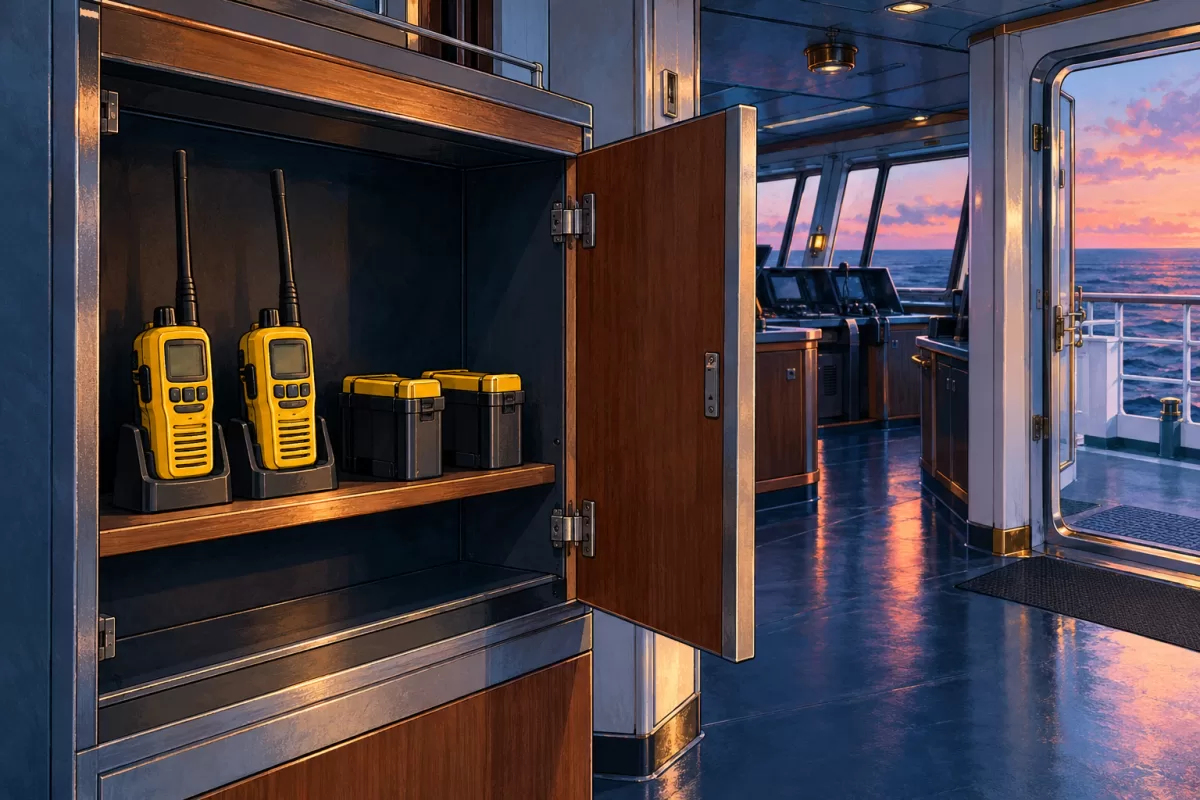
Clause 4.11.1 covers portable radios together with their primary emergency batteries. They must be readily accessible on the navigation bridge. Another room that remains unlocked throughout the voyage is permitted if the equipment can be carried more quickly and easily from there to every lifeboat and liferaft.
Assess access to the equipment and the route to each survival craft. The same clause requires easy access without tools where the radios are stored in a locked cabinet. Specify the cabinet and access method as part of the installation.
For a quotation, attach a plan or clear photographs of the storage position and the routes to the survival craft. Show the doors, cabinet, shelving and other items stored there, and explain how the crew retrieves each set. The illustration on this page does not establish that a specific location is acceptable.
What the crew takes with the radio
For the NTW-1000, NSR's V16 brochure lists the NBT200 emergency battery, the rechargeable NBT200C, a charger, an adapter and accessories. These power sources serve different purposes. The equipment list should show which battery is reserved for emergencies and which supports routine operation.
Clause 4.11.2 requires the primary battery to be sealed for emergency use only and marked with an expiry date by the supplier. If the seal is broken, the battery is considered discharged and used, and a new battery will be required at survey to provide eight hours of emergency operation. Equipment testing or surveying must not require the use of a new battery.
Do not plan a routine demonstration that requires opening the emergency batteries. Follow the manual and the agreed test programme. A separate article in this series covers expiry dates and external markings. Here, the priority is keeping the equipment ready and accessible for transfer.
Rechargeable batteries and storage markings
If a radio with a rechargeable battery is used for onboard communications, clause 4.11.3 requires a charger. The emergency equipment must remain ready independently of that routine use. In the equipment schedule, list radios in service, emergency batteries and rechargeable batteries separately. Do not derive their quantities solely from the number of charging slots.
Under clause 4.11.4, the radios must carry water-resistant markings with the vessel name and call sign and indicate the channel in use. Clause 4.11.5 requires a clearly visible symbol at the storage position as specified in the applicable IMO resolutions. A model advertising label does not meet that marking requirement.
| Item | What to record before ordering |
|---|---|
| Storage location | Actual location, access, cabinet and method of opening it without tools |
| Routes | Transfer to each designated lifeboat and liferaft |
| Emergency equipment | Radio, matching primary battery, seal and markings |
| Equipment for routine use | Rechargeable batteries and the chargers required |
| Identifier | Vessel markings on the radios and visible symbol at the storage position |
What the supply should deliver
The agreed equipment list should link each radio to its batteries, accessories, documents and storage position. On receipt, check the model and part numbers, seal condition, markings and actual quantities. Assess access and transfer under the applicable requirements and vessel programme. This article sets no single time or distance for all transfer routes.
For a quotation for the NTW-1000 please give the vessel details, required quantity, existing radios and chargers, proposed storage location and designated survival craft. Include any work required, the delivery city and requested timing. We confirm the version, documentation, condition, contents, availability and price for the specific supply, with emergency and routine-use batteries listed separately.
Sources: RKO: amendment to Part VII under Order No. 29-p, 1.1.2, 1.1.5, 4.11.1–4.11.5; NSR NTW-1000, V16 brochure.
More in this series
- Portable GMDSS: gloved operation and readiness for use
- New equipment near the magnetic compass: what to agree
- Echo-sounder trunk: access and water detection
- AIS: accounting for audible fault alarms
- NGR3000 antenna: information needed before choosing a location
- Echo-sounder cable: routing, shielding and deck connections
- EPIRB: float-free release and access to the container
- AIS-SART: the mounting arrangement is part of the package
- NTW-1000: checking the emergency-battery expiry date
- Echo-sounder transducer: conditions around the installation site
- Position source for GMDSS: include power supply in the brief
- AIS pilot plug: what to agree for the bridge
- DSC watchkeeping: the alarm must cover the whole bridge
- NAVTEX: bringing an SAR message to the watchkeeper's attention
- Speed log for a project: speed through the water or over the ground
- EPIRB for a particular vessel: data, markings and documents
- AIS class in the enquiry: start with the vessel's requirement