Echo-sounder trunk: access and water detection
RS and RKO rules: practical application
When replacing NSR NED-3010 the quotation may cover the display, transducer, cable, and mounting accessories. If the vessel uses a trunk to house the primary transducer, include the trunk's condition and construction in the retrofit requirements. A photo of the new display does not show this part of the installation.
When this guide applies
Section 3.3 of Part V, Navigational Equipment, of the RS Rules for the Equipment of Sea-Going Ships covers the log and/or echo sounder trunk. This article uses the edition dated 1 January 2026. Clause 1.1.1 applies to self-propelled ships not engaged in international voyages and to the relevant equipment. Flag Administration instructions are addressed under clause 1.1.3.
This article covers installations with a trunk. It does not prescribe a trunk for every echo sounder or provide procedures for entering a space, opening closures, or carrying out hull work. Determine the installation from the ship's design and the transducer documentation.
Access must suit the installed equipment
Clause 3.3.1.1 ties trunk dimensions to access to the primary transducers. For a replacement, compare the existing arrangement, the new transducer, and the required maintenance access. Matching the sounding frequency does not establish that the geometry is suitable.
For selection, provide a drawing of the trunk, the existing transducer and mounting assembly designations, available dimensions, and a description of parts to retain. The contractor determines how to inspect the space and what work is necessary. The purchase list must account for the actual installation site even if the display remains at its existing station.
Closures, access ladders, and water detection have separate requirements
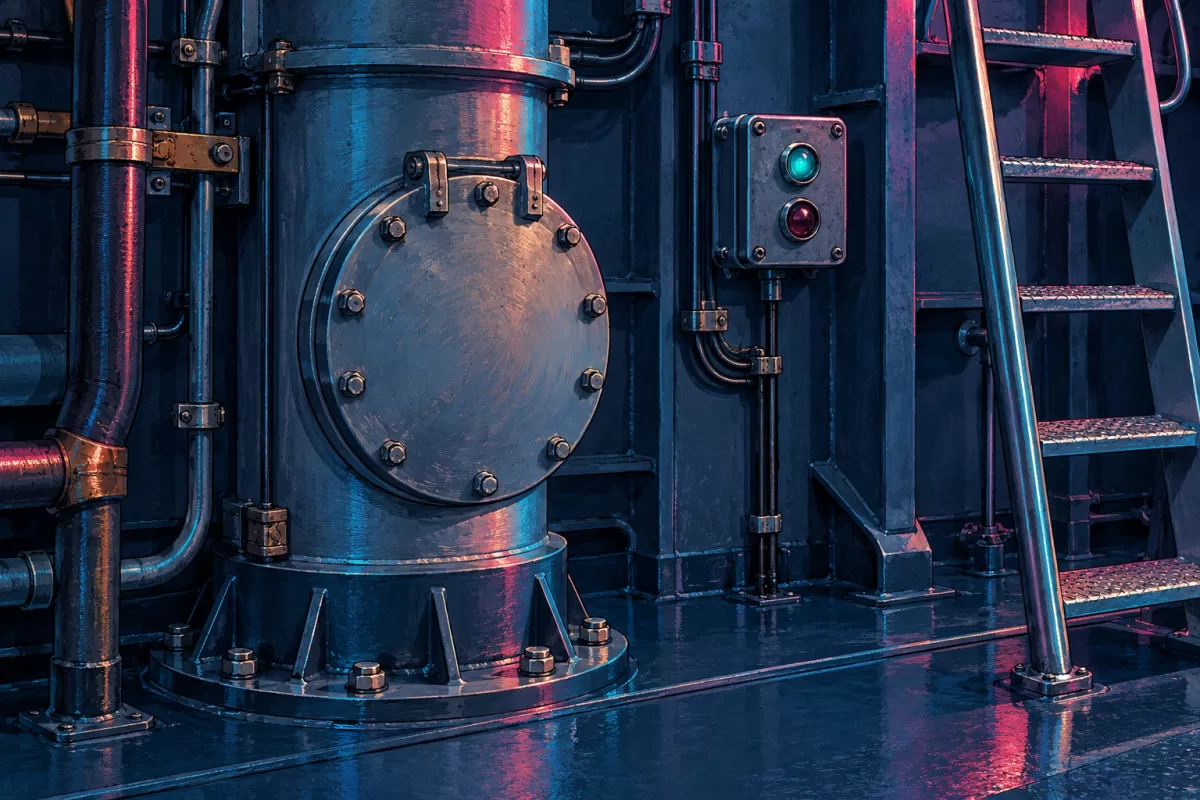
Clauses 3.3.1.2 and 3.3.1.3 provide for closure by a sliding watertight door or a manhole with a bolted cover, plus a ladder or rung ladder for descent. Clause 3.3.1.4 covers watertightness testing and refers to the methods in Part II, Hull, of the Rules for the Classification and Construction of Sea-Going Ships.
Clause 3.3.1.5 requires a way to detect water in the trunk. Examples include a test cock, a sounding pipe, a water sensor, and other arrangements. The rule does not prescribe one sensor chosen by a seller for every trunk. Record the method specified in the design and its condition in the project inputs.
What to provide for a replacement quotation
| Part of the installation | Information to collect |
|---|---|
| Transducer | Full designation, available documentation, and mounting arrangement |
| Trunk and mounting assembly | Drawing, available dimensions, and structural parts to retain |
| Access and closure | Specified arrangement and known issues |
| Water detection | Method specified in the design and its known condition |
| Work scope | Scope of hull, installation, and acceptance work |
The table helps prepare an enquiry. A design survey is still required. For a trunk in the cargo tank area of a tanker, also consider clause 3.3.2. Provide the ship type and trunk location with the initial enquiry.
Coordinate echo sounder supply with installation readiness
The company's product listing NED-3010 describes the offered package. Confirm the exact transducer, mounting tank, and accessory designations in the current quotation. Including a tank in the package does not establish that the existing trunk is suitable or that hull work is ready to proceed.
First list what will be retained and what will be replaced. Then agree on the equipment, additional materials, site preparation, and the documented outcome of the work. This makes it possible to align equipment delivery with the vessel's retrofit schedule. Confirm availability, condition, documentation, and price for the specific configuration separately.
Sources
- RS: Part V, edition of 1 January 2026: clauses 1.1.1, 1.1.3, and 3.3.1–3.3.2.
- NSR NED-3010 — SpectraTech product listing.
The enquiry prompts are practical editorial guidance. Sources reviewed in Astana on 25 October 2026.