TKR-D710E: A repeater with a separate dispatcher station
Equipment: functions and package contents
The company's TKR-D710E listing describes both repeater and base station operation. Check this wording against the primary documentation before ordering a dispatcher station. Kenwood's TKR-D710/D810 family brochure specifies repeater operation and expressly excludes duplex or simplex base operation.
Kenwood TKR-D710E in the group catalog
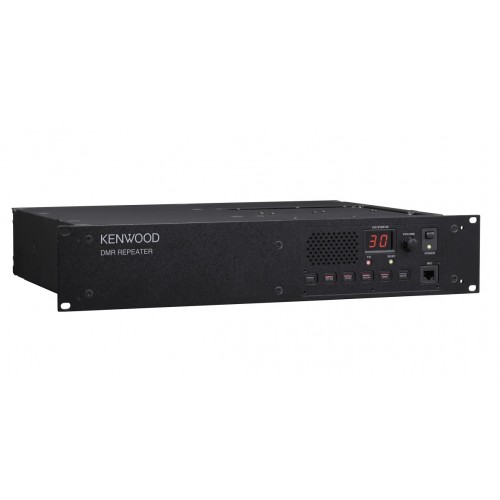
Identify the unit's role first
A fixed radio installation and a dedicated operator station are different parts of a system. At one site, staff use compatible subscriber radios through a repeater. Another site may also require a dispatcher station with its own way of controlling communications. Buying the TKR-D710E hardware alone does not define what that station includes.
Describe the intended result in the enquiry: who needs to talk to whom, where the dispatcher will sit, and which controls are needed. The contractor can then specify the hardware. A speaker, a two-digit display, and front-panel buttons do not establish an undocumented subscriber operating mode.
Network features need their own components
In its detailed TKR-D710/D810 specification, Kenwood lists Conventional IP Network and the AIS IP console interface. Both require a KTI-5 interface unit with IP Network software installed.
These specifications give a basis for discussing console operation. They do not establish that every unit has an operational IP system. If the console is required, the quotation should identify the KTI-5, the software configuration, and a compatible console. Confirm separately that these components are available and suitable for the offered TKR-D710E.
Here AIS stands for Application Interface Standard, the DMR Association's protocol for voice and data. It denotes a DMR console interface. Spell it out in the project documents so the same acronym is not mistaken for a different type of equipment.
How to compare two quotations
First check whether both quotations cover the same outcome. One may supply a repeater for an existing network, while another adds a dispatcher station. The second needs an explicit component list and an agreed communications test. Its cost cannot be derived by subtracting the prices of two base units.
For an existing site, include a list of subscriber radios, the current radio installation and dispatcher station, and the planned changes. Identify any equipment to be retained. This helps specify the missing part of the communications path when asking for a quotation.
Acceptance can include checking communication between the intended users and the dispatcher's operations in the agreed configuration. If a network interface is ordered, test the whole path. A feature listed in the brochure is not a test report for the delivered configuration.
What to confirm before delivery
The TKR-D710E is listed in the Inlight group catalog. Ask for a full hardware list that identifies the repeater's role, accessories for the radio installation, and the separate operator station if needed. Distinguish the TKR-D710/D810 family from the exact E variant being offered.
The quotation confirms condition, software features, package contents, documents, price, and lead time. Agree on design, setup, testing, and delivery separately. Describe the working communications path and the required operator station within the limits of the primary documentation.
Sources: JVCKENWOOD, TK-D240/D340 family brochure CL836KM-E-2, with a separate TKR-D710/D810 section; JVCKENWOOD, TKRD710/D810 specCL851K-E-2.