NSR NSI-1000: Class A AIS at a ship’s navigation station
The NSR NSI-1000 is a shipborne Class A AIS transponder with a separate display. On the bridge it exchanges information automatically and gives the navigator additional information about received AIS targets. The station includes a transceiver, display, antennas and agreed integration with navigation equipment. This review describes what the installation provides and its limits.
Request a quote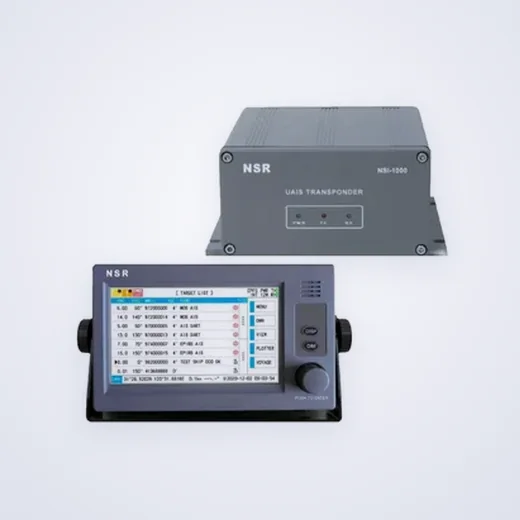
SpectraTech catalogue photograph of the NSR NSI-1000 transponder and separate display. Antennas, cables and other parts are out of view. Confirm exact versions and condition in the quotation.
Two-way exchange of information
AIS exchanges identification and navigation data over VHF between equipped vessels and shore stations. Specify the NSI-1000 as a transponder. The station transmits own-vessel information, receives messages and displays them for the bridge watch.
Other AIS participants receive the designated vessel information, and the bridge watch can compare received data with the situation around the vessel. The station does not require a subscription to an internet vessel map. Appearance on a shore web service does not establish installation quality, because the web service and onboard station receive information through different paths.
Class A identifies the equipment type. Confirm applicability, package and required documents in the vessel project. Compare equipment that meets the installation requirements. Price and a shared AIS label do not establish that another class is suitable.
Target list and relative positions
The NSI-1000 manual describes Target List and Plotter Display. The list shows individual target details and the plotter shows their positions relative to own ship. These are two views of received information. Position the display where the watch can use it.
The manufacturer specifies a seven-inch colour touchscreen with brightness adjustment. A dedicated display is useful when other bridge displays have their own tasks. If AIS targets are also to appear on radar or an electronic chart, specify that data exchange in the design. A dedicated display neither prevents integration nor establishes compatibility with every installed instrument.
Determine where the watch needs each type of information. The NSI-1000 display may suffice for one bridge. Another may require agreed output to existing navigation equipment. Discuss this when defining the equipment and work, before positioning the units.
The display can show different AIS participants
The NSI-1000 distinguishes Class A and Class B vessel targets, shore stations, AIS aids to navigation and search-and-rescue devices. Symbols help identify the role of a received target, such as an aid to navigation or a vessel. Assess how the display presents these categories as well as its size.
The manufacturer lists compatibility with AIS-SART, AIS MOB and AIS EPIRB messages. The NSI-1000 receives their messages. It does not replace an emergency beacon or personal locator. Specify each distress device for its own purpose and keep the AIS transponder as a separate part of the installation.
The display presents information from radio messages. AIS does not measure shoreline, depth or every physical obstacle. Target information supplements radar, echo sounder and the bridge watch, which retain their separate roles.
Transceiver and antennas serve different functions
SpectraTech lists the NSI-1000 with transceiver, 7-inch display, GLONASS/GPS antenna with 20 m cable, VHF antenna with mount and cables. The photo shows only the transponder and display. Keep the antennas and accessories in the agreed specification even though they are out of view.
The satellite and VHF antennas serve different parts of the system. Identify available locations, cable runs, distances to the bridge and existing radio equipment. Cable lengths vary by vessel. Agree on a complete installation package with accessories and overall price so minor connecting parts are accounted for.
AIS in the navigation station
The NSI-1000 provides interfaces for radar, ECDIS, BAM, gyrocompass and external GNSS equipment. It exchanges data over RS422. Confirm integration for the specific instruments and versions. A list of ports does not establish what information will be used or where it will appear.
The navigator decides manoeuvres. An information system does not automatically prevent collisions. Reception and transmission depend on installation condition and radio conditions. Specify how the NSI-1000 fits the bridge workflow, including its own display, connections and verified functions.
Package price and supply
SpectraTech lists the NSI-1000 as available for shipment from stock. Confirm current stock, exact version, condition, contents and document applicability in the quotation. Give the vessel, station requirements and receiving city in Russia or Kazakhstan. We quote an overall price for the package and discuss installation, configuration and delivery separately.
NSI-1000 in our catalogue
The NSI-1000 listing shows stock availability. The described package includes transceiver, 7-inch display, GNSS antenna with 20 m cable, VHF antenna with mounting hardware, cables and documents. We confirm version, condition, availability, contents, overall price and applicable documents in the quotation. Work and delivery are separate. This listing does not constitute a public offer.
Request a quotePrimary source: NSR NSI-1000: Class A, display and interfaces; NSI-1000 User Manual UM.E 20230118-09, sections 1.1–1.5 and 5.1–5.2. Manufacturer specifications do not establish the actual package or operating conditions aboard a particular vessel.